The $399 Pocket Revolution: 25 Years Since the iPod Changed Music
Two decades and a half ago, Apple’s original iPod redefined personal audio by fitting a thousand songs into a device no larger than a playing card.
By Ama Boateng ·
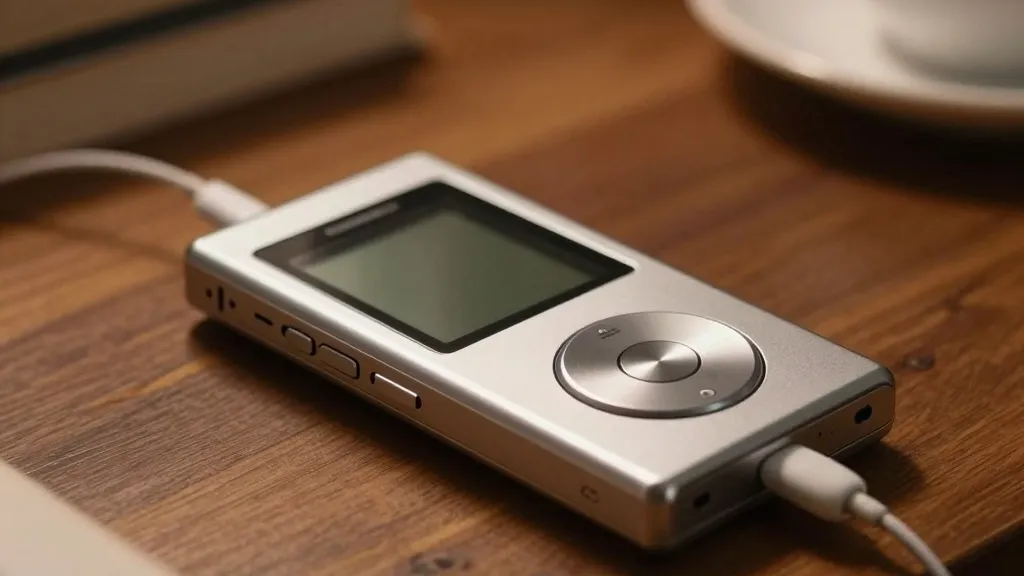
In 2001, a single device with 5 gigabytes of storage and a price tag of $399 fundamentally altered how millions of people in New York and New Jersey consumed audio. That year, Apple CEO Steve Jobs unveiled the original iPod, a pocket-sized digital music player that promised to hold an entire music library in a form factor the size of a deck of cards. At a time when the dot-com bubble had recently burst and Apple was still recovering its corporate footing, the launch marked a pivotal moment in consumer electronics.
The presentation began with Jobs teasing a "breakthrough digital device that’s not a Mac." By October 2001, the company had successfully steered itself beyond the beige era of old hardware into the Mac OS X period, with iBooks and iMacs already established in the market. Jobs envisioned the Mac as the central hub of a user’s digital life, connecting cameras, camcorders, and DVD players. He identified portable music as a massive, yet leaderless, market, noting that while companies like Sony, Creative, and Sonic Blue had products, none had yet found the right recipe for digital music.
The device itself was introduced as an MP3 player capable of CD-quality sound and support for MP3, WAV, and AIFF formats. The 5GB capacity was the headline feature, allowing users to store 1,000 songs. Specifically, this referred to 1,000 typical pop tracks encoded at 160Kbps. Jobs argued that for the average consumer, this capacity represented their entire personal music collection, a claim that resonated with a generation accustomed to carrying bulky CD cases.
The physical design of the iPod was a direct result of advancements in storage technology. It utilized a 1.8-inch diameter, 0.2-inch thick hard drive from Toshiba, which was ultra-compact and ultra-thin for the time. This engineering allowed the final device to measure just 2.4 by 4 by 0.78 inches and weigh only 6.5 ounces. Jobs emphasized that the player was lighter than most cell phones of the era, making it an ultra-portable companion for daily commutes.
Beyond its size, the iPod offered technical advantages over its competitors. It featured 20-minute skip protection and rapid file transfer speeds via a single FireWire 400 cable. Apple marketed it as the first and only music player with this connection, claiming it could transfer an entire CD’s worth of data in five to 10 seconds. In contrast, USB connections at the time required approximately five minutes for the same transfer. To fill the entire 5GB drive, the process took an estimated 10 minutes, a significant improvement over the five hours required for USB-based players.
Powering the device was a rechargeable lithium-polymer battery that provided 10 hours of continuous playback. Apple stated that an empty battery could be recharged to 80 percent in just one hour. The interface was designed for one-handed operation, featuring an accelerated scroll wheel with a piezoelectric clicker for tactile feedback. This allowed users to quickly locate tracks by playlist, artist, or song title. During the stage demonstration, the first track played was "Building a Mystery" by Sarah MacLachlan.
The launch was synchronized with the release of iTunes 2, which introduced features like MP3 CD burning and auto-sync capabilities. This auto-sync ensured that any library curated on a Mac was automatically updated on the iPod during connection for charging or transfer. The device also functioned as a FireWire hard disk drive. While the first iPhone did not arrive until early 2007, the iPod and iPhone coexisted in Apple’s product lineup for over a decade.
The iPod’s cultural dominance eventually waned as smartphones matured and made dedicated music players redundant. The final model, the 7th-generation iPod Touch, was released in May 2019. Although the product line was left without updates for several years, it was officially discontinued in May 2022. Twenty-five years later, the original device remains a landmark in technology history, representing the moment when personal audio became truly mobile.
Source: Tom's Hardware